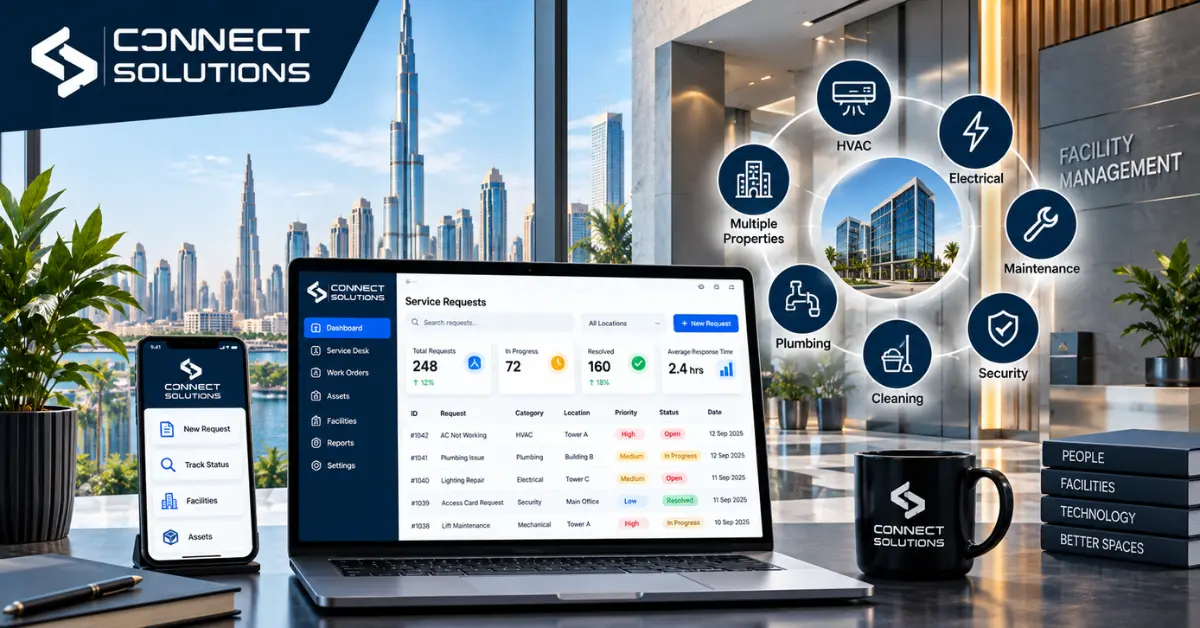
Knows this drill by heart. The first dozen service calls come in by lunchtime, techs are already deployed to two or three locations, and someone is wondering why last Tuesday’s AC call is not yet resolved. That is precisely the problem that service desk software in the UAE is beginning to solve.
Simply put, service desk software offers facility management staff an integrated system through which to handle service requests, create tickets, allocate techs, manage SLA deadlines, and communicate with clients or tenants throughout the whole process. Instead of managing their business via multiple WhatsApp messages and an outdated.
For organizations managing commercial real estate properties, communities, malls, or hospitals in Dubai and Abu Dhabi, such centralization has become a necessity instead of being an option. It usually distinguishes the team that successfully meets its SLAs from the team that continuously provides reasons for failing to meet them.
What Is Service Desk Software for Facility Management?
Service desk software for facility management is a system built to capture physical-property service requests, convert them into trackable tickets, and manage them through to resolution.
That’s a meaningfully different job from a typical IT service desk, even though the two are frequently confused. An IT helpdesk handles password resets and network access. A facility management helpdesk deals with issues you can physically see and touch, and ones that are usually causing real inconvenience for someone on the ground:
- AC problems
- Plumbing issues
- Electrical faults
- Cleaning requests
- Elevator complaints
- Equipment failures
- Preventive maintenance
- Building inspections
For anyone searching specifically for FM work order management software, this distinction is worth understanding early. A generic IT ticketing tool has no fields for assets, technicians, or property-level SLAs, because it was never designed with facility operations in mind. Purpose-built facility management software UAE companies rely on is structured around exactly these requirements from the ground up.
How Does a Facility Management Service Desk Work?
Most modern platforms follow a fairly consistent operational flow:
Request → Ticket → Priority → Assignment → Technician → Work Order → Resolution → Verification → Closure
Request to Assignment
A tenant or internal team member submits a request through an app, a portal, or even a QR code posted on-site. The system generates a ticket automatically rather than relying on someone to log it manually later. Priority gets assigned immediately, since a burst pipe clearly takes precedence over a flickering hallway light, and the ticket routes to the appropriate technician based on skill, location, or current workload, typically within seconds rather than after a manager manually checks availability.
SLA Timer to Closure
Once a technician is assigned, the SLA clock begins tracking response and resolution time against the agreed contract terms. The technician receives the work order on a mobile device, complete with photos and access notes, and updates the job status as work progresses. Once complete, they log completion evidence, and the ticket closes into that asset’s service history.
That last step carries more weight than it might seem at first. When a single asset fails for the third time in six months, service history is what actually indicates it’s time for replacement rather than another temporary repair.
Key Features Facility Management Companies Should Look For
Key Features Facility Management Companies Should Look For
A handful of features tend to come up repeatedly once companies start comparing platforms, and most of them solve a problem FM teams have already run into firsthand.
- Service Request and Ticket Management – captures requests from tenants, customers, and internal teams so nothing gets lost in a WhatsApp thread
- Work Order Management – tracks each request from creation through completion instead of leaving it as an informal note someone might get to eventually
- SLA Management – flags deadlines automatically before they turn into breaches, which is usually where companies notice the biggest shift
- Technician Assignment – matches jobs to whoever’s actually available, nearby, and qualified, not just whoever picked up the phone
- Preventive Maintenance – the most underused feature on this list, and the one that saves real money over a year even when it doesn’t feel urgent today
- Asset Management – ties service and maintenance history to specific equipment, so you’re working from actual records instead of memory
- Mobile Access – lets technicians update and close jobs from the field, no trip back to the office required
- Dashboards and Reports – pull open tickets, response times, and SLA compliance into one view instead of someone compiling it by hand.
Why UAE Facility Management Companies Need Service Desk Software
Facility management in the UAE comes with a specific set of operational pressures. Managing multiple buildings across Dubai and Abu Dhabi means coordinating a high volume of requests, several technicians, and often a number of subcontractors, all simultaneously. SLA-based contracts add further pressure, since falling behind on too many deadlines puts the contract itself at risk, not just a single unresolved repair.
Preventive maintenance across mixed-use developments, tenant communication that frequently needs to happen in both Arabic and English, and properties spread across the emirates all add layers of complexity that a spreadsheet was never designed to manage. Connect Solutions built its platform with exactly this kind of operational complexity in mind, since generic tools tend to fall short once a company is managing more than a handful of properties.
Benefits of Service Desk Software for Facility Management Companies
The benefits here are practical rather than theoretical, and they tend to show up within the first few weeks of switching over.
Requests reach the right technician faster once assignment is no longer manual, and managers can see SLA deadlines approaching well before they turn into breaches. Every request leaves a permanent, trackable record instead of getting lost in a group chat. Technicians can see their assigned priorities from a single screen instead of receiving instructions piecemeal, and customers receive automatic status updates rather than having to call the FM office repeatedly for information.
For management, the clearest advantage is visibility. Dashboards and KPIs replace the need to manually check in for updates, and every action gets logged against the relevant property or asset, building a service history that holds up when it’s actually needed.
Interested in seeing this in action across your own properties? A short walkthrough usually explains it better than any feature list.
Service Desk vs. CAFM vs. CMMS: What’s the Difference?
Companies researching FM software often use these terms interchangeably, so it’s worth clarifying the distinction.
| System | Main Purpose |
| Service Desk | Manage service requests, tickets, and communication |
| CMMS | Manage maintenance, assets, and work orders |
| CAFM | Manage broader facility operations, assets, space, and maintenance |
For most facility management companies, the more effective approach is an integrated platform combining service desk, work orders, maintenance, assets, SLA tracking, and reporting, rather than operating across three disconnected systems that rarely stay in sync.
How Service Desk Software Handles a Typical UAE FM Request
Consider a tenant in a Business Bay tower who reports a leaking pipe under the kitchen sink through the tenant portal, at 9 pm on a weeknight, which is often when these issues surface. The system creates a ticket immediately, classifies it as high priority due to water damage risk, and assigns the nearest available plumbing technician within minutes, with the unit number, access instructions, and photos already attached to the mobile work order.
The technician arrives, resolves the leak, logs before-and-after photos, and closes the ticket. The property manager never had to make a single phone call that evening, the tenant received an update the moment help was dispatched, and the entire interaction is now part of that unit’s permanent service history.
How to Choose Service Desk Software in the UAE
A few considerations matter more than an impressive feature list once it’s time to compare platforms seriously, and it’s easy to be drawn in by a polished demo that doesn’t hold up under real use.
Look for software built specifically for UAE facility management operations, rather than a repurposed IT helpdesk with a new interface. Verify that it handles multi-property operations properly, since that’s typically where lower-cost tools begin to fall short. Confirm mobile access for technicians, since a platform limited to desktop use isn’t much help to someone standing in front of a malfunctioning elevator. SLA tracking should be a core feature rather than an add-on, and reporting should be clear enough that a property manager will actually use it regularly.
How Service Desk Software Supports Multi-Site FM Operations
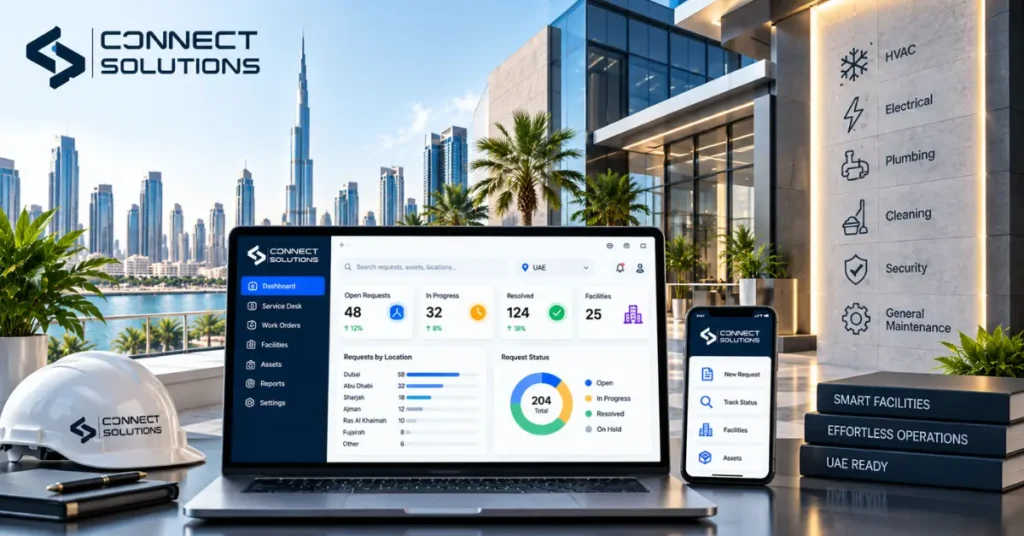
For companies managing several properties simultaneously, the operational complexity increases quickly. Multiple properties mean multiple service requests and multiple technicians, along with a genuine risk of losing visibility into what’s happening where, particularly during busy periods.
A centralized dashboard resolves this with property-level ticket tracking, allowing managers to see what’s open at each site without switching between separate systems. Technician workload becomes visible across the entire portfolio rather than one building at a time, and site-specific SLAs, asset history, and contractor performance all consolidate into a single view for leadership.
KPIs Facility Management Companies Can Track
Once requests and work orders live in a single system, a set of key figures starts to tell the real story: average response time, resolution time, SLA compliance rate, technician utilization, first-time fix rate, and recurring issues by asset.
None of these are particularly complex metrics on their own. The challenge is tracking them consistently by hand, which is exactly why most companies don’t have visibility into them until something’s already gone wrong.
Frequently Asked Questions
What is service desk software in facility management?
It’s a system that captures maintenance and service requests from tenants or customers, converts them into tickets and work orders, and tracks them through to resolution.
How does a facility management service desk work?
A request comes in, becomes a ticket, gets assigned a priority, is routed to a technician, is tracked against an SLA, and closes once the work is verified.
What is the best service desk software in the UAE?
The right choice depends on portfolio size and operational needs, but it’s worth prioritizing platforms built specifically around multi-property FM operations rather than generic IT ticketing tools. Connect Solutions is built with exactly that focus.
How does service desk software help facility management companies?
It centralizes requests, accelerates technician dispatch, keeps SLAs on track, and gives managers genuine visibility into activity across every property under their management.
What is the difference between a service desk and a helpdesk?
In practice, the terms are often used interchangeably. A facility management service desk specifically handles physical-property requests such as maintenance and repairs, while a generic helpdesk typically refers to IT support.
Can service desk software track SLA performance?
Yes. It tracks response and resolution times against contract terms and flags tickets at risk of breaching before deadlines pass.
Can technicians receive work orders on mobile?
Yes, technicians receive work orders, access details, and job history directly on their phones, updating status from the field rather than returning to an office.
Can service desk software manage multiple properties?
Yes, multi-property and multi-site management is one of the primary reasons UAE facility management companies move away from spreadsheets in the first place.
Conclusion
Operating facility management services across the UAE without a proper service desk system means facing the same recurring challenges week after week: missed requests, SLA breaches, and technicians without clear visibility into what’s next on their schedule.
Service desk software UAE facility management companies increasingly rely on turns that operational chaos into something trackable, from the first ticket through to final closure. Once a company is managing more than a handful of properties, this kind of system stops being a convenience and becomes a genuine operational necessity.
Want to see how Connect Solutions handles this for teams managing multiple UAE properties? Call +92 300 1110365 or email info@connect-sol.com to set up a walkthrough.