Ask a service company owner in Dubai what actually eats into their margins, and it’s rarely the high, obvious costs. It’s the small stuff: a spare part used on a job that never made it onto the invoice, a quotation that took two days to send because someone had to manually type it up, a job marked “completed” that was actually never fully closed out.
Job management software exists to close exactly these gaps. Not by adding more admin work, but by turning every job, from the moment it’s created to the moment it’s invoiced, into one connected record instead of five disconnected steps.
Here’s what good job management software actually looks like for a Dubai service company, and what tends to separate the platforms that genuinely work from the ones that just look good in a demo.
What Job Management Software Actually Does
Job management software tracks a service job through its full lifecycle: creation, technician assignment, work performed, parts and services used, quotation, customer approval, and closure. The point isn’t just to record that a job happened; it’s to make sure every job is priced, tracked, and closed correctly, every time, without depending on someone’s memory at the end of the day.
For a Dubai service company, a job record typically needs to hold:
- Customer and location details
- Job category, sub-category, and fault
- Assigned technician and priority
- Service charges, transport charges, and parts used
- Discounts, VAT, and total cost breakdown
- Quotation status and customer approval
- A full timeline of every status change
When all of this lives in one job card instead of being scattered across a call log, a technician’s notebook, and an invoice typed up later, two things happen: jobs get closed faster, and pricing actually matches what was done.
The Real Cost of Managing Jobs Without a System
Dubai’s service market is competitive and fast-moving; property managers, facility operators, and homeowners expect quick turnaround and accurate billing. Companies still managing jobs through spreadsheets and phone calls tend to hit the same recurring problems:
- Jobs get double-booked because there’s no shared view of technician availability
- Spare parts get used but not logged, so the invoice undercharges without anyone noticing
- Quotations take too long because someone has to manually reconstruct what was used on the job before they can price it
- Job status is unclear, so management can’t tell which jobs are actually profitable and which are quietly losing money
- Nothing connects to inventory, so stock counts drift further from reality every week
None of these is a dramatic failure on its own. They’re small leaks. But across dozens of jobs a month, they add up to a meaningful chunk of missed revenue, the kind that’s nearly invisible until you actually put a system in place and see the numbers shift.
Streamline Your Job Management Today
Experience how seamlessly our software manages your specific complaint types, job cards, and field technicians.
Book Your Live Demo or chat with us instantly on WhatsApp.
What to Look For in Job Management Software
- A job card that builds itself as the work happens: The best systems don’t require someone to reconstruct a job card after the fact. As a technician logs parts and services, the job card and eventually the quotation are built automatically.
- Configurable job types, categories, and fault lists: Dubai service companies span very different work: HVAC, electrical, IT hardware, CCTV. Job management software should let you define your own categories, sub-categories, and faults instead of forcing a generic template.
- Real inventory integration: When a part is used on a job, it should come out of stock automatically, priced correctly, without a separate manual inventory update.
- Warranty-aware quotation logic: In-warranty jobs shouldn’t generate a quotation at all. Out-of-warranty jobs should generate one automatically from the job card this single feature removes a huge amount of billing friction.
- An approval workflow, not an email chain: Quotations should move through Pending, Approved, and Rejected states inside the same system, visible to whoever needs to see them, instead of living in someone’s inbox.
- Reporting that shows job profitability, not just job count: Knowing how many jobs closed this month is useful. Knowing which jobs are actually profitable after parts, transport, and technician time is what actually helps you run the business better.
How Connect Solutions Handles Job Management for Dubai Service Companies
Connect Solutions was built specifically around this full job lifecycle, so nothing gets lost between “job created” and “invoice sent.”
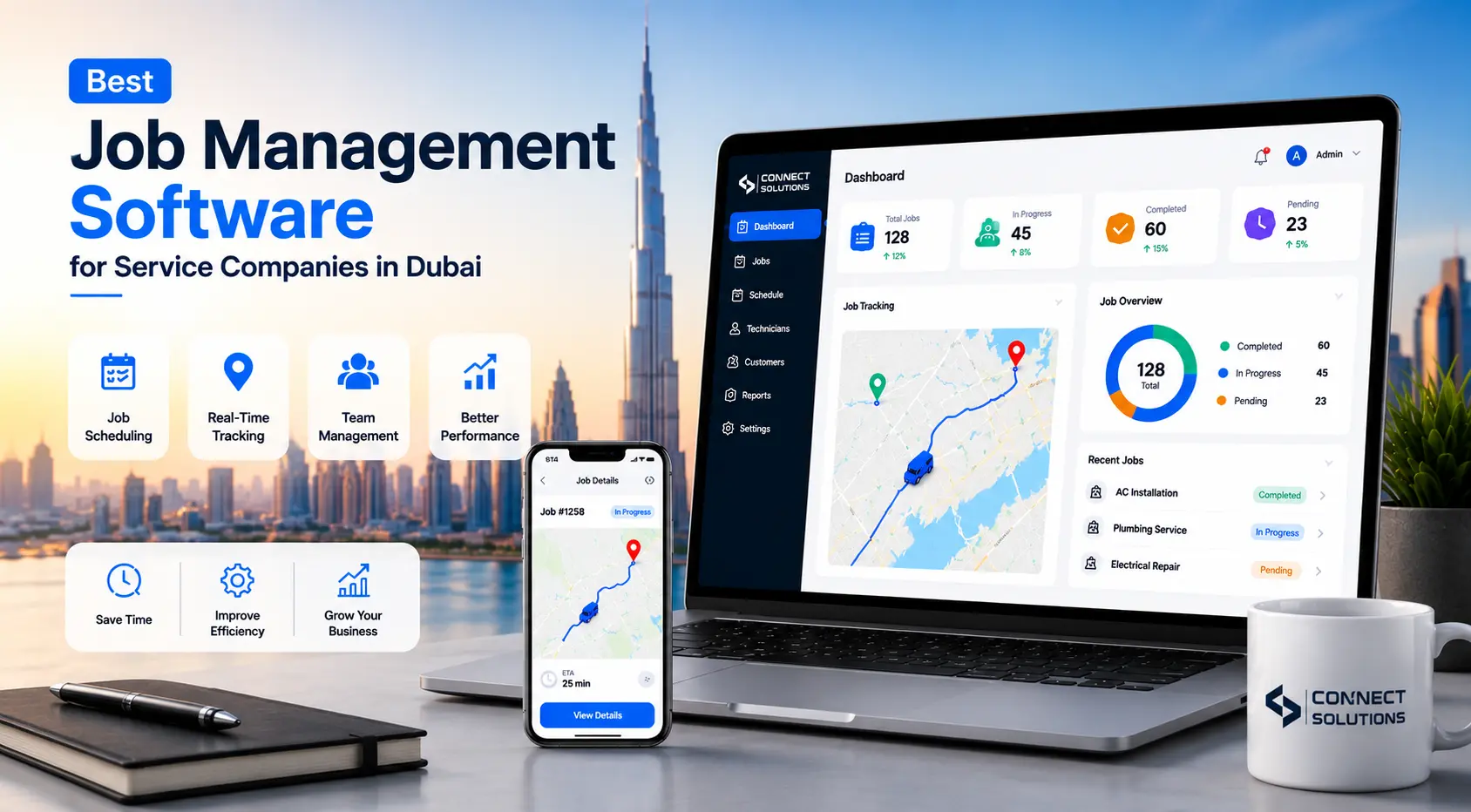
- Complete job cards: Every job carries a category, sub-category, fault, priority, assigned technician, warranty status, and estimated completion time, configurable to match how your business actually categorizes work, not a fixed generic list.
- Automatic cost breakdown: As service charges, transport charges, and parts are added to a job, whether by a CSR in the office or a technician in the field, Connect Solutions calculates discounts, VAT, and total cost automatically, so the numbers are always current.
- Inventory that updates itself: Every spare part consumed on a job is deducted from stock and priced correctly, keeping inventory counts and job costs aligned without a manual reconciliation step.
- Quotations generated from real job data: Out-of-warranty jobs generate a quotation automatically from the parts and services actually logged on the job card, no retyping, no guessing what was used.
- One approval queue: Quotations move through Pending, Approved, and Rejected states in a single queue visible to whoever’s responsible for sign-off, with full quotation history against every job.
- Job timeline and documents: Every status change, comment, and attached document sits against the job permanently, so any job’s full history of who did what, when, and what it cost is available months later without digging through old messages.
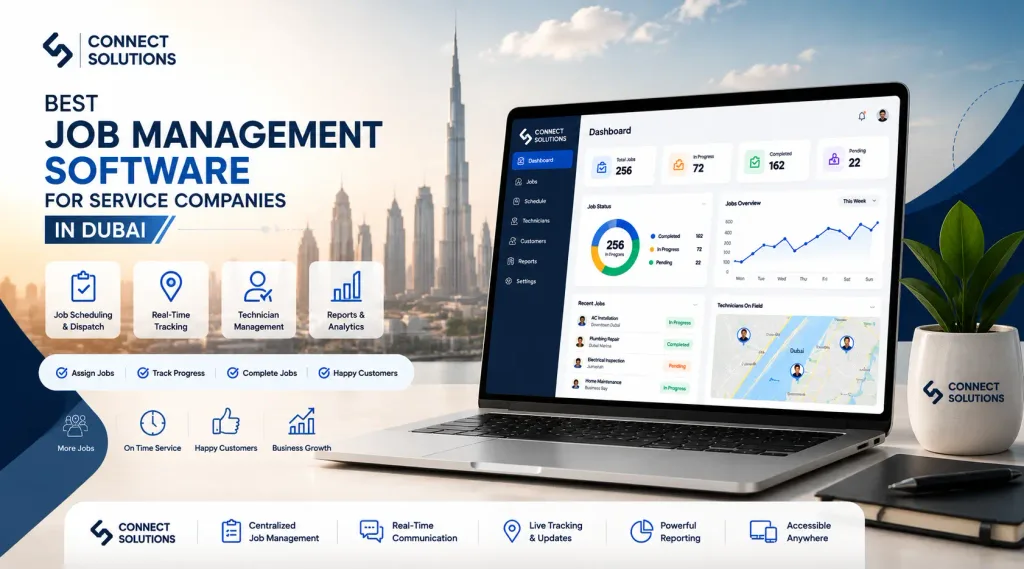
- Live dashboards on job performance: Open jobs, resolved jobs, average resolution time, and job reopening rate are all visible in real time, so management can see which job types or technicians are performing well and which need attention.
What Changes When Jobs Are Actually Managed Properly
Dubai service companies that move from manual job tracking to a real job management system typically see three shifts within the first few weeks:
- Quotations go out same-day instead of taking two or three days to compile.
- Spare part costs get captured accurately, closing a leak that was previously invisible.
- Job status becomes something management can actually see, instead of something they find out about when a customer calls to ask.
Job Management Software vs. Basic Invoicing Tools
It’s worth separating this clearly: invoicing software creates a bill. Job management software tracks the entire job that leads to that bill technician assignment, work performed, parts used, quotation approval, and only then produces an accurate invoice from real data.
A lot of Dubai service companies start with basic invoicing tools and eventually hit the same wall: the invoice is only as accurate as what someone manually typed into it. Job management software removes that manual step entirely because the invoice is built from the actual job record, not reconstructed from memory afterward.
FAQs
What’s the difference between job management software and field service management software?
They overlap significantly. Job management typically focuses on the job card, costing, and quotation side, while field service management also covers GPS tracking and technician dispatch. A platform like Connect Solutions combines both, since Dubai service companies generally need each piece to work together.
Can job management software handle multiple job types in one system?
Yes, categories, sub-categories, and fault lists should be fully configurable so HVAC jobs, electrical jobs, and IT hardware jobs can all run through the same platform without forcing a one-size-fits-all template.
Does job management software help with VAT compliance in the UAE?
Job cards and quotations should calculate VAT automatically as part of the cost breakdown, keeping pricing consistent and accurate for UAE VAT requirements.
How quickly can a Dubai service company get started with job management software?
Most companies can import existing customers and inventory via Excel and be logging live jobs within days, without a lengthy implementation project.
Streamline your complaint resolution and technician dispatching with Connect Solutions. Let us show you what our platform can do using your real operational scenarios.
- Schedule: Book a Demo with Connect Solutions
- Call/WhatsApp (PK): +92 300 1110365
- Call (UAE): +971 457 13703
- Email: info@connect-sol.com